
Table modifications
Clicking "+" expands the component's content. There are two types of fields in the columns.
- Editable fields:
- "VISIBLE" - allows you to change the component's visibility; possible values are " Yes " or " No."
- "RESOLVED" - allows you to change the resolution status of components, functions, and constraints.
- "CONFIGURATION" - This column lists the configurations available for the component, allowing you to change the component's configuration or control a property or configuration in the document. It also displays the constraint type when you expand the component.
Note: You can create a new configuration.
- "EDIT" - Enables editing of the component; possible values are " Yes " or " No."
- Fields that cannot be edited:
- "COMPONENTS" displays the full names of the components as well as the names of their functions, constraints, and properties when you expand the component.
- "Type " displays the type of object on this line (part component, assembly component, property, function, dimension).
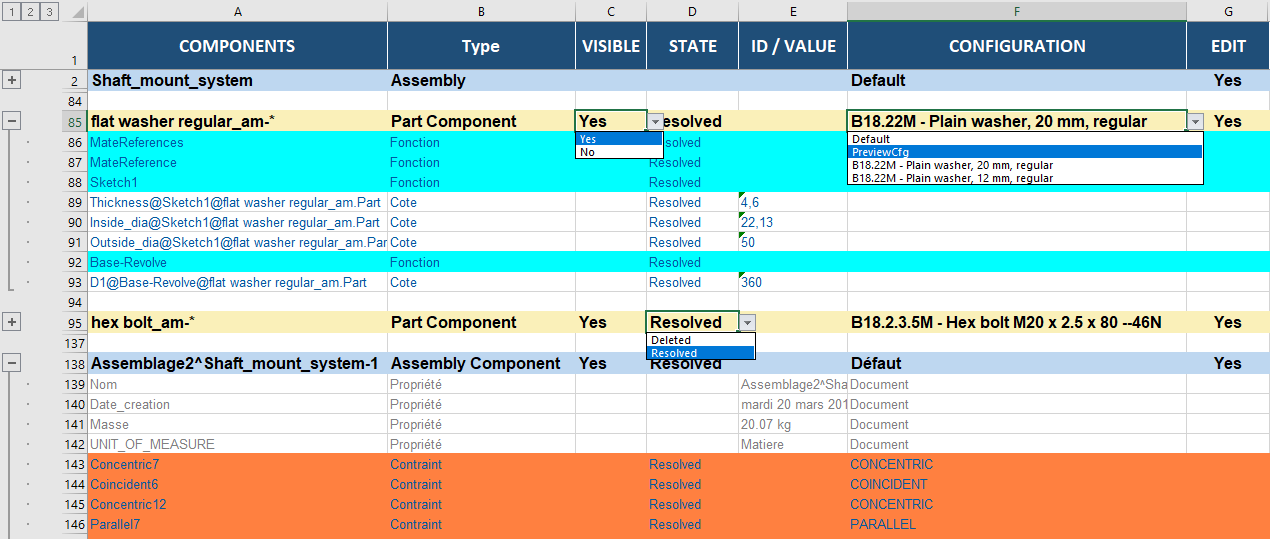
The different cells allow you to enter data based on their type:
- manual entries (Dimensions, Description, Properties, etc.)
- drop-down list fields
- "YES/NO"
- "Resolved/Deleted"
- Select one of the configurations listed in the document. For this cell, you can create a new configuration by entering a new name.
All of these cells can also be modified using formulas, equations, etc., by taking advantage of Microsoft Excel's features.
To delete the contents of a table, there are two options:
- By pressing the
 you delete the entire contents of the table.
- By pressing theBuilding the table"
 to reload all the information. Attention clicking on this function will overwrite any information you have already modified in the table!
You can delete lines to display only a portion of an assembly.
 It is imperative to preserve the parenthood of components so that functions do not fail to rebuild (constraints between components, functions dependent on each other, etc.).