
General Options
The myPDMtools suite of tools includes options that are common to all tools, which can be accessed through the following window:
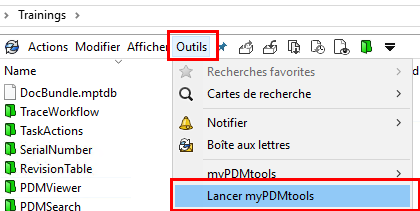
- Open the PDM view in Windows Explorer and log in as the Admin user
- Launch myPDMtools from the Tools menu in Windows Explorer
 It is possible to assign access rights per user group to the options myPDMtools in the setting rights definition.
This window contains the general options and all the tools that can be activated from the context menu or via a button on the data map.
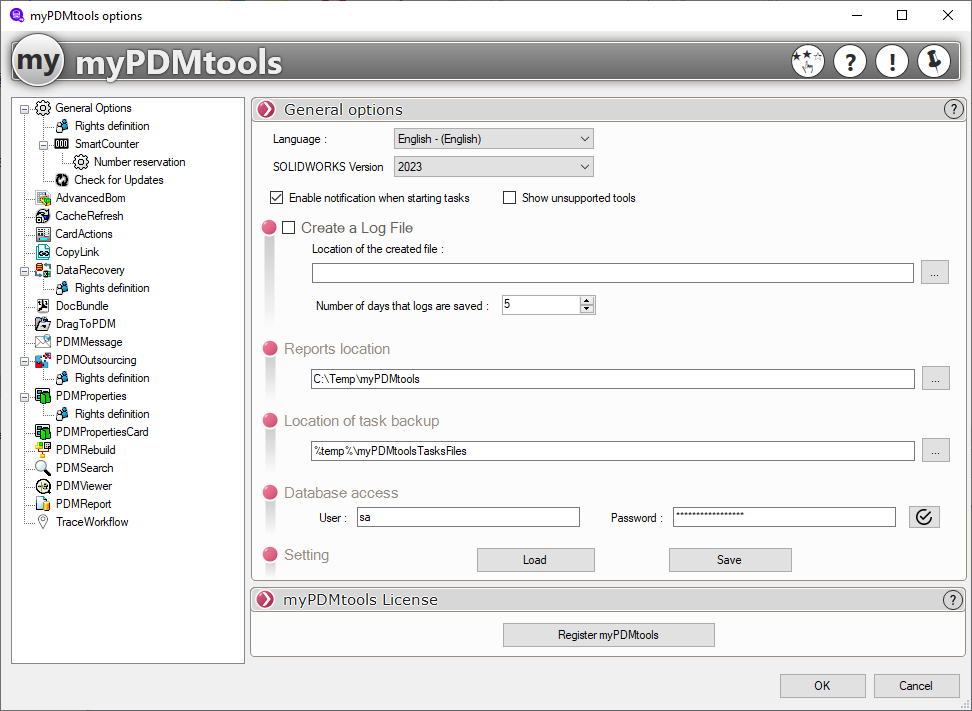
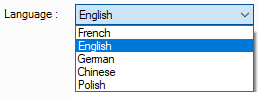
- Language selection:
- Selecting a SOLIDWORKS version:
Allows you to specify a specific version of SOLIDWORKS for myPDMtools if multiple versions are installed on the computer
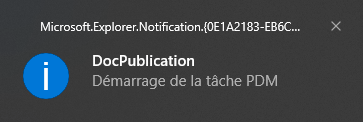
- Enable notifications when tasks are launched:
When a myPDMtools task is launched, a Windows notification appears if the option is checked:
- Show unsupported tools:
The following myPDMtools tools are no longer supported:
DynamicList (To be used in CardActions from now on)
PDMCheck (This tool has been replaced by PDMReport)
SerialNumber (The CardActions tool allows you to generate and rename documents using SmartCounter serial numbers)
- Create a log file:
This checkbox allows you to enable or disable the creation of a log file in a specific folder each time a myPDMtools tool is run.
If this option is not checked, logs are automatically generated in the Windows temporary files folder, in the "myPDMtoolslogsfiles" folder.
- Location of the generated log file:
You can select a local folder, but it is best to centralize all logs on the network by specifying a network path.
In both cases, Windows users who use the myPDMtools tools must have the necessary Windows permissions for this folder (read and write access to files).
- Number of days to retain logs:
By default, myPDMtools retains logs for 5 days. You can increase or decrease this setting.
- Location of reports:
You can select a local folder, but you can also centralize all reports on the network by specifying a network path.
Task reports will also be available directly in the task details.
- Location of the task backup:
As soon as a task is created, a backup of its options is saved at this location (.mpt).
- Access to the database:
For a number of tools, you must connect to the SQL Server database using a user with administrator privileges. (For example, TaskProperties, which is used in both the TaskActions task tool and CardActions.)

It is possible to test the connection to the SQL database, after entering the user and password, click on 
If the username and password combination is valid, the following message will appear:
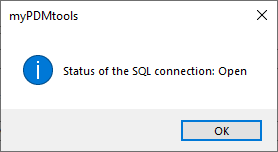
Otherwise, the following message will appear:
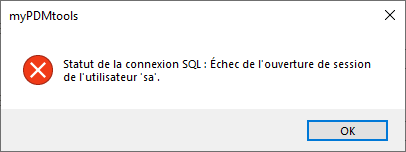
- Favorites:
This section allows you to save and open settings bookmarks. All settings in the myPDMtools Options window will be saved.
The Save button saves the settings from the Options dialog box to a settings file (.mpt).
The "Load" button allows you to restore previously saved options from an .mpt file.