
Options

In this section, we configure the settings for exporting bills of materials to Excel.
The first tab allows you to:
- Specify the folder where your Excel bill of materials examples (templates) are saved. You can select templates in "xls" or "xlsx" format.
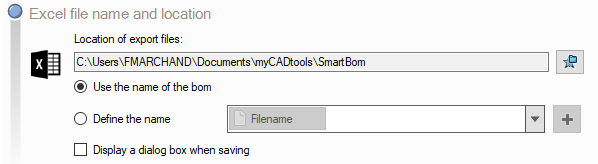
- You can specify the directory and the name of the Excel export file. You can choose to use the name of the current bill of materials or create a new name using the renaming tool. This folder can be located locally or on the network so that it can be shared with multiple workstations.
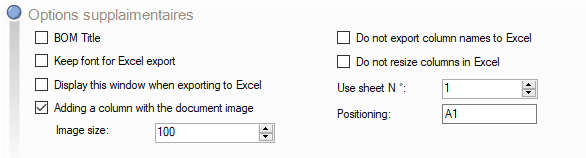
- BOM Title: Displays, at the top of the bill of materials, the name of the bill of materials defined in the project.
- Keep the font for export to Excel: If the font has been changed , you can keep it by checking this box; otherwise, the font defined in the Excel template will be applied.
- Show this window when exporting to Excel: You can choose to have this dialog box open when saving the file.
- Do not export column names: If this option is checked, the column names will not be displayed in the Excel bill of materials.
- Do not resize columns in Excel: If this option is checked, column resizing is disabled, and the columns remain as they are in the template.
- Add a column with the document image: this allows you to preview 3D models in your Excel spreadsheet
- The bill of materials can be inserted starting from a specific position (column-row) if, for example, there is information that needs to appear before the bill of materials (such as a logo, date, company information, etc.). Note that one sheet per bill of materials, as specified in the project, will be automatically created in the Excel export file.
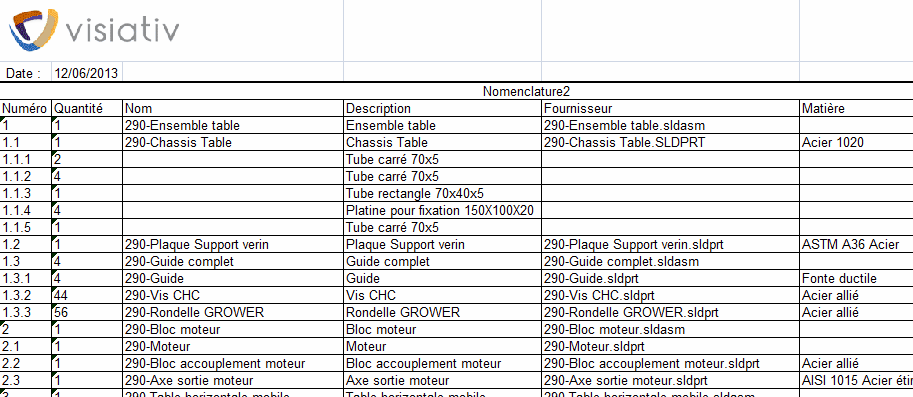
Example:
Tip:
You can also name your starting cell and then retrieve that name in the SmartBOM options as follows:
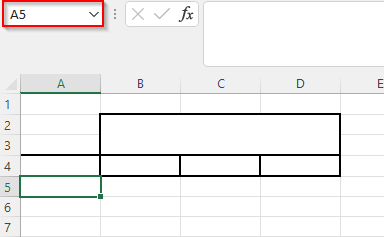 →
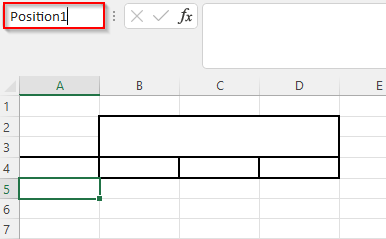
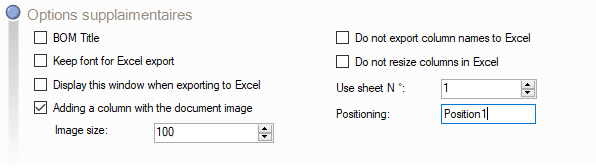
This allows you to have different Excel templates with different BOM starting points but with similar SmartBOM settings.