
Conditional
Using a simple drag-and-drop, place the " Conditional " icon in the desired location in the " Properties " column. Alternatively, double-click the " Conditional " icon.
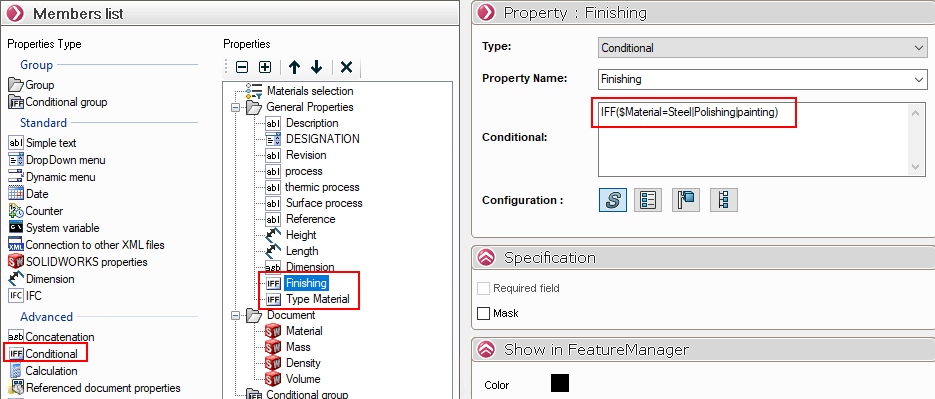
A property defined in this way allows you to use conditions within the properties.
The command line is entered in the " Conditional " field. The " IFF " syntax can be used in uppercase or lowercase (" iff "). The “|” character is entered by pressing the “Alt Gr” and “6” keys together. To retrieve a property, place the “$” character before the property name (case-sensitive).
 The '' typeConditional'' must be located in the column ''.Properties'' after the properties it retrieves.
Examples:
The " Finition" property you created should be populated using the following syntax:
IFF($Material = Steel | Polishing | Painting)
If the " Material " property is equal to "Steel," then the " Finish " property will be equal to " Polished "; otherwise, the " Finish " property will be equal to " Painted."
The " Type Matiere " property you created should be populated using the following syntax:
IFF($Material=Steel|$IfSteel|$Other)
If the " Material " property is equal to "Steel," then the " Material Type " property will be equal to the " Steel " property; otherwise, the " Material Type " property will be equal to the " Other " property.
You can also nest multiple conditions one after another. There's no limit!
IFF( $Material=Steel|IFF ($Material=Alloy Steel|$SteelType|$Other))
The syntax above is incorrect because the IFF must always appear in the ELSE clause.
The correct syntax is:
IF($Material=Steel|$IfSteel|IF($Material=Alloy Steel|$SteelType|$Other))
- If the " Material " property is equal to " Steel," then the " MaterialType " property takes on the value of the " IfSteel " property.
Otherwise
- If the " Material " property is equal to " Alloy Steel," then the " MaterialType " property takes on the value of the " SteelType " property.
Otherwise
- The " TypeMatiere " property retrieves the value of the " Autre " property.
For equality conditions, you can use the following syntaxes:
"=" (equals) for text or numeric values.
"<>" (not equal to) for text or numeric values.
">", ">=", "<", "<=" for numeric values.
It is also possible to use concatenation—by using the ''&'' character —in ''IFF'' statements.
Fractional values are recognized in " IFF " statements.
Example - Depending on the value of the " Scale" property, the " Format" property meets the following condition:
IFF($Scale=1/2|$Format=A4|A3) the value " 1/2 " returns " 0.5 ". If the value of the “Scale” property is “0.5,” then the “Format” property will be set to “A4”; otherwise, it will be set to “A3.”
You can use the wildcard character "*" in conditional operations:
*Steel,to include values ending with the characters "Steel."
Steel* to include values that begin with the characters "Steel."
*Steel* to include values containing the characters "Steel."